Last Thursday, Spokes Dunedin sent in its submission for the DCC’s draft 10-year plan. From a cycling – as well as walking and public transport – point of view, it is very disappointing: the automobile continues to dominate funding.
Please download and read our submission using the link below – your feedback and thoughts are always welcome:
This morning, Spokes Dunedin met up with Chris Henderson, Group Manager of Waste and Environmental Solutions at the DCC, to talk about our submission regarding the Litter Compliance Policy review:
Even though it was an agreeable chat, the take home message was sadly not as agreeable.
Essentially, changes to the Litter Compliance Policy won’t encourage the principle enforcers involved, e.g., the police and university proctor, to take more action than they already are. This is because the main issue remains: a lack of resources. The fine is too low ($150 through the uni; $400 via the DCC) for resources to be used to identify the perpetrators. Therefore, even if CCTV was used for such incidents – which it’s (legally) not – the time and effort it would take to find out who a culprit was, is not deemed proportional.
Chris explained that the resources are also not available for regularly clearing up litter strewn throughout the city, as opposed to only certain (central) areas.
He felt that the best bet is to await the beverage container return scheme, which should roll out throughout the country in the next couple of years:
One of the new provisions will grant the proctor the power to issue a Notice to Clear Rubbish where a student residence has a significant rubbish issue: “The rubbish would need to either be a health and safety issue or have a negative visual impact on others. Failure to comply could result in fines.” The premise must be occupied by a student and be “visible from a public place or from the property of another and having an adverse effect on the visual amenity of that place or property; or such as to comprise a hazard to health or safety of any person.”
Yet, the High Court has confirmed that the university’s responsibility for “good government and discipline” goes beyond the boundaries of the physical campus to cover the way in which members of the university community interact with one another and with the wider community.
In this sense, such action shouldn’t be confined to the premise, but explicitly include the public space around the premise: it’s the smashed glass and other litter in these public spaces that presents a hazard for the wider community.
Ultimately, however, more focus should be place on preventative measures: such anti-social behaviour should be curbed and the University of Otago has massive part to play in this.
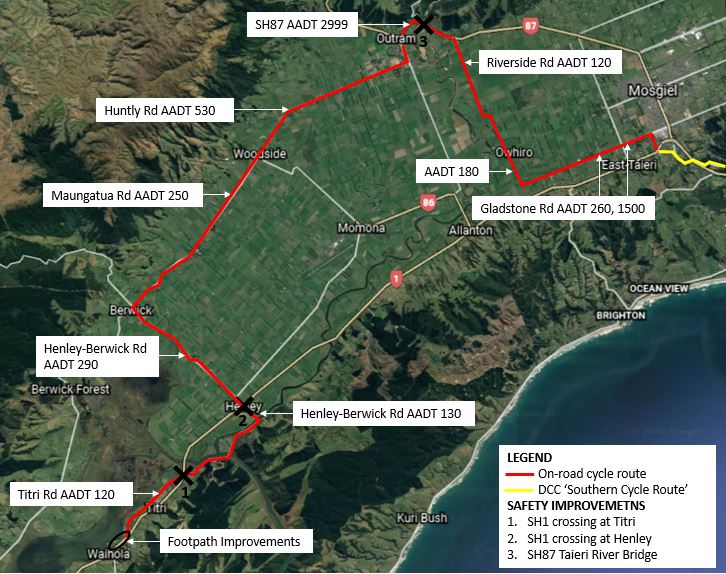
On Wednesday, Spokes Dunedin submitted its thoughts on the DCC’s proposed Dunedin to Waihola Heartland Ride.
Essentially, while we’re delighted to see the Council working to create a southern access cycling route, we can’t support what’s proposed in its current form, because we don’t believe it represents a safe, realistic or viable cycling route worthy of any special designation, and any such branding would, in our opinion, create unrealistic expectations for any cyclist unfamiliar with the area.
Please access our full submission using the link below:
The following day, we received a response from Josh Aldridge, who is part of the team working on the ride (which includes Waka Kotahi, DCC, Mosgiel-Taieri Community Board, and Clutha District Council):
Thank you for your feedback on the proposed Dunedin to Waihola Heartland Ride route. We appreciate that this route in its current form is not perfect however we believe it is the best route using existing infrastructure and see this as the first step towards better cycling connections heading south from Dunedin.
Dunedin City Council has worked with Waka Kotahi over the past months to investigate potential routes and agree on the best route using existing infrastructure which meets the New Zealand Cycle Trails Design Guidelines for an on-road route based on traffic volumes, speeds and road conditions
As you’re probably aware, the ‘Heartland Rides’ are predominantly on-road routes which are approved by Waka Kotahi and promoted by NZCT on their website. The purpose of these rides are to link Great Rides with towns and cities to form a well connected New Zealand Cycle Network (NZCN). Waka Kotahi have ongoing funding to extend and enhance the NZCN and priority is given to projects which are on the network. For example there is potential for a path along the banks of the Silverstream and dedicated pedestrian/cycle bridge over the Taieri River which would provide a safer and more direct route between Outram and Momona Airport.
In response to your specific concerns:We acknowledge the current cycle route into the city is not up to the expected standard of cycleways in Dunedin. However, over time, and subject to funding availability, we aim to continue to improve the cycle network across the city, including the Tunnels Trail and the southern cycle route. DCC has been working to upgrade and correct the wayfinding signage along the Southern Cycle Route, with the help of additional funding from Waka Kotahi. We are happy to receive feedback from Spokes on any missing or incorrect signs, and other areas that could be improved.
The Tunnels Trail is included as part of the Dunedin Urban Cycleways programme which was approved through the 2018 10 Year Plan, and therefore is not a new capital project and is not required to be consulted on through the 2021 10 Year Plan. Additionally, within the Dunedin Urban Cycleways programme we are also looking at improving the walking and cycling infrastructure along Main Road in Fairfield and South Road through Caversham, and there is also a safety project looking at Main South Road through Green Island. These projects intend to improve safety and accessibility along the routes, which will have a positive impact on the Southern Cycle Route into the city.
Waka Kotahi are continually working on improvements to the NZCN with particular attention to projects within the State Highway network. Making Dunedin to Waihola a designated Heartland Ride will mean that Waka Kotahi will immediately fund safety signage at the three locations identified in the proposal in the short term and increase the chances of Waka Kotahi funding a new crossing of the Taieri River in the medium to long term.
We accept that this route is not the most direct and Riverside Road is not sealed. While the roads are narrow, given the low traffic volumes, the likelihood of two vehicles approaching in opposite directions is very low. Installing wayfinding and warning signs will increase awareness of cyclists and improve safety. Alternatively, the new bridge on Gladfield Road is expected to be completed by 1 July this year, and could incorporate this route to reduce the distance along unsealed roads. We will investigate the impact of this option, and include if suitable.
Fundamentally, we’re not satisfied with this response. So! What our our next steps? Short-term, we plan to consult with other Ōtepoti Dunedin-based groups interested in this proposal, before taking up Josh’s offer to discuss this response further. Longer-term, we plan to put together a business case that basically spells out the massive benefits of cycling tourism.
Watch this space…
In the meantime, please share your own thoughts on the proposed route.
What with the ten year plan being drafted, Spokes Dunedin is collecting ideas for infrastructure improvements across Ōtepoti Dunedin, such as bike parking, cycleways, road safety signs, etc. Simply click on the link below and fill in the Google form:
We’ve started putting together our submission for the ten year plan and are also keen to get your input on the draft itself. It’s available online here:
The main gist is that this policy actually be enforced! Smashed glass shouldn’t simply be cleared up: those who purposefully smash it should be punished for their actions.






 SPOKES Dunedin